
Butler County Supervision Systems
Butler County has a firm two-system boundary. Butler County Adult Probation handles county probation and county parole. State parole after a Pennsylvania Department of Corrections sentence is administered by PADOC field staff, while the Pennsylvania Parole Board makes the release decision. The state directory notes that PADOC generally has no jurisdiction over county probation and parole offices. A search must therefore start with the sentence, not with a broad guess about which agency holds the file.
Parole is conditional release before a custodial term expires. Probation is a court-ordered sentence served in the community, though restrictive conditions may include partial confinement, work release, electronic monitoring, house arrest, or day reporting. Both involve rules and oversight. Neither word means that every legal obligation has ended. County parole can follow time in Butler County Prison, while state parole follows a PADOC sentence.
| Record type | Who controls it | Best verification route |
|---|---|---|
| County probation | Butler County Adult Probation and the sentencing court | County office plus the Butler County docket |
| County parole | County authorities | Adult Probation and Butler County Prison release record |
| State parole | Pennsylvania Parole Board and PADOC field staff | Supervised Individual Locator, office finder, and Board Action |
| Final discharge | The agency that held supervision authority | Written discharge or archival agency record |
- Parole
- Conditional community release before the sentence term ends.
- Probation
- A court sentence supervised in the community instead of, or after, confinement.
- Absconder
- A person an agency alleges has stopped reporting as required.
- Discharge
- The formal end of the agency's supervision authority.
Verify Butler County Post-Release Supervision
A correct check matches the person, sentence, and custody system. Do not treat a warrant list as a roster of all supervised people. Do not treat a state locator as a county probation database. The PADOC locator has one mode for people currently incarcerated under state jurisdiction and another for people currently under department supervision. The supervised-person mode may provide county-of-residence and district-office context, but it does not establish an exact jail-door release time.
- Open the criminal docket and identify whether the sentence was county probation, county parole, or state confinement.
- For a county sentence, contact Butler County Adult Probation and use the docket number to distinguish common names.
- For state parole, search the Department Supervised Individual Locator by name or parole identifiers.
- Use the PADOC parole office finder for the current supervising office rather than relying on an old address.
- If neither current search resolves the question, request the Board Action, discharge record, or other agency record that states the status.
A positive state locator match supports current PADOC supervision context. It does not prove the exact date a person left prison. A negative result may mean final discharge, a name mismatch, a different jurisdiction, or a data issue. Butler County release verification works best when the supervision result is paired with the court docket or the actual release record described on the Butler County released inmate search.
Important: “Released from prison” and “off supervision” are different findings. Confirm each with the authority responsible for that stage.
Butler County Supervision Office
County supervision is handled at the Adult Probation office, not by the state locator. The office can address county reporting instructions and county-case status within the limits of what staff may disclose. Bring or provide the docket number when possible. House Arrest has its own telephone line because that form of restrictive supervision has different operational needs.
Butler County Adult Probation
124 West Diamond Street
Butler, PA
Mail: P.O. Box 1208, Butler, PA 16003
Phone: 724-284-5259
House Arrest: 724-431-2162
For a state-parole case, use the live PADOC office finder for Butler County or the Western Field Region. State office assignments can change, so a saved address should not override the current locator or the reporting instructions issued before release. The sentencing docket helps identify the legal track, but it is not a substitute for an agency's current supervision record.
The official Butler County directory shows the county office and its published reporting schedule.
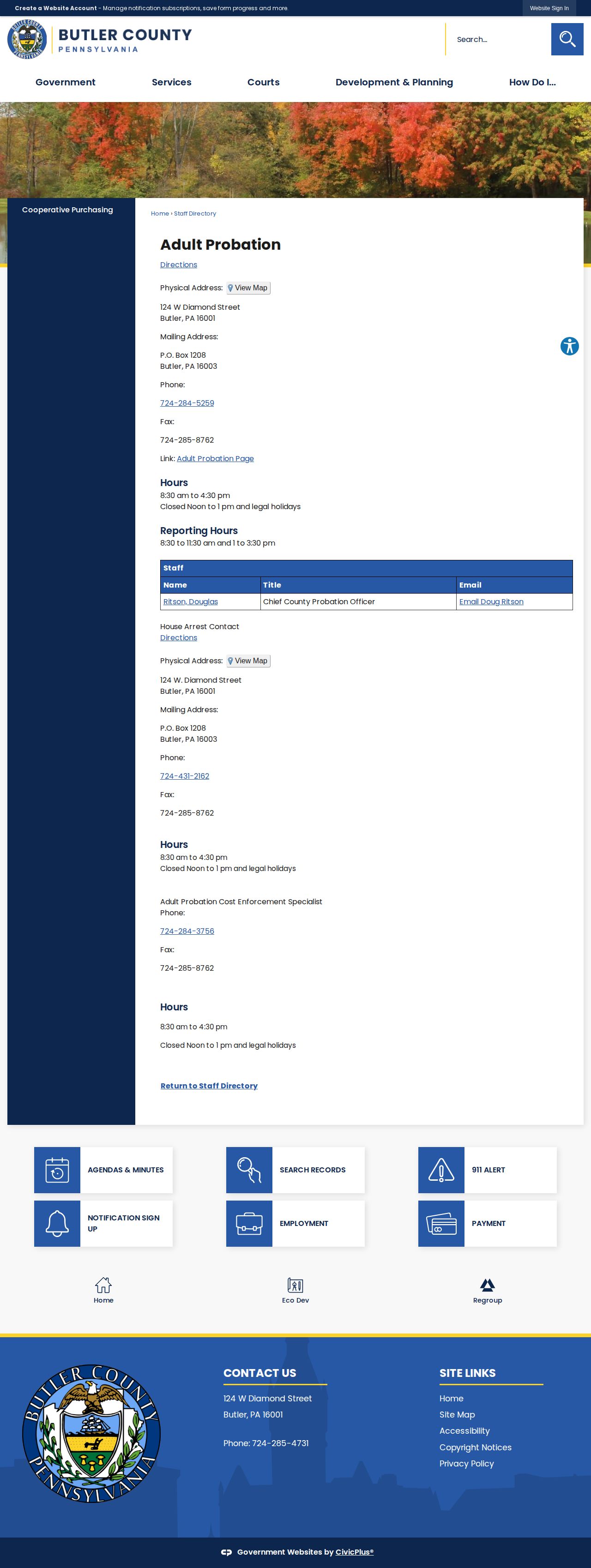
The capture confirms that county reporting has local windows that should not be confused with PADOC state-parole office hours.
Butler County Reporting Windows
Butler County publishes unusually precise reporting hours. General office hours are 8:30 a.m. to 4:30 p.m. The office closes from noon to 1 p.m. and on legal holidays. Published reporting periods are 8:30 to 11:30 a.m. and 1 to 3:30 p.m. These windows matter when a released person needs to check an instruction, report in person, or resolve which county unit holds the case.
A reporting window is not evidence of a person's release date. Nor does an office closure extend or erase a court or supervision duty without agency confirmation. Use the exact written instructions issued for the case. If those instructions conflict with a public directory, call the office and preserve the answer with the date and staff unit when appropriate.
Note: County reporting hours apply to Butler County supervision, while state-parole reporting follows the assigned PADOC field office and release instructions.
Butler County Release Conditions
The county's published conditions show why release is a change in custody, not the end of control. A person may have reporting duties, travel limits, treatment requirements, testing, financial obligations, or court-ordered restrictive conditions. The exact terms come from the order and supervision paperwork. General web text cannot establish which conditions apply to one person.
A violation can lead to investigation, a court response, revocation, or a return to custody, depending on the supervision type and authority. Revocation means the responsible body withdraws a prior community status after the required process. For county matters, the court and county office carry the controlling record. For state parole, the Parole Board and PADOC record the action. A return to prison after a violation does not change the historical fact that a prior release occurred.
Supervision ends through a formal discharge, maximum-date expiration where applicable, court action, or another documented agency action. An old release record proves the earlier custody event, but only a current supervision record or final discharge record resolves whether authority remains.
Butler County Warrants and Absconders
Butler's Sheriff provides a public active-warrant portal. Pennsylvania separately offers a Most Wanted Parole Absconders service. These are different tools. Neither is a full supervision roster, and neither gives the date of an earlier release. A warrant match also does not prove current incarceration.
Names require careful matching. Compare a docket number, date of birth or approximate age, supervision identifiers, and the issuing authority. Do not merge two people because a name and county look alike. The state absconder list is limited to selected people alleged not to be reporting as required, so absence from it says nothing about whether someone is on parole.
Do not confront a person shown in either service. Pennsylvania directs absconder information to 800-932-4857 or RA-CRabscondertips@pa.gov. Questions about a Butler warrant should go through the Sheriff or court channel identified by the portal.
Note: A warrant or absconder listing supports only the agency's published allegation, not a community-release date or current custody location.
Butler County Release Reintegration
The Butler County Community Reintegration Program is a real local transition program. It began in June 2012 for sentenced Butler County Prison inmates serving at least three months. Its work includes treatment and services, risk-and-needs planning, approved outside activity, health, family ties, and help with documentation. Those details make it relevant to release preparation rather than a generic statewide program.
Participation can support a parole plan and a safer move back to the community. It does not prove that parole was granted, that release occurred, or that post-release supervision ended. The person remains within the Prison's custody framework until a separate lawful release event is recorded. A program record and a release record answer different questions.
The official county program page shows who the transition service is built to serve.
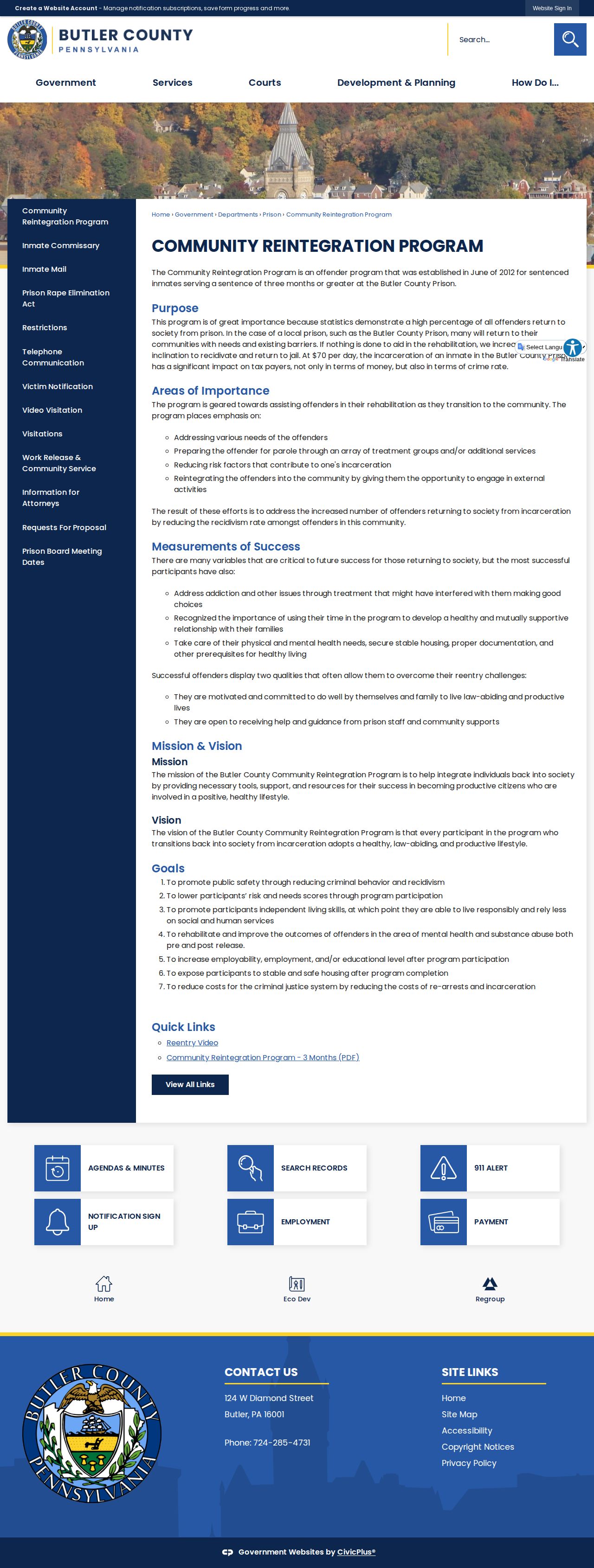
The program description helps explain preparation for community supervision while preserving the distinction between participation and actual discharge.
Butler County State Parole Records
The Pennsylvania Parole Board makes state parole decisions. A minimum sentence date is usually the first point at which the Board may exercise discretion, not an automatic release date. A Board Action can grant parole to the street, grant parole to a detainer, refuse parole, defer action, require more review, or later rescind or supersede an earlier action. Preserve the Board's exact words.
No official public name-by-name calendar of upcoming state parole interviews and no public person-specific database of Board Actions was found in the research sweep. Aggregate monthly reports cannot prove an individual result. For a named person, use the Board Action, a Board Decision inquiry at RA-PMPBPPWEBCONTACT@pa.gov, a properly framed Board records request, and the PADOC supervision locator where current parole is plausible.
Parole to a detainer is not community release. A favorable Board decision also may precede actual departure while a home plan, program, or other prerequisite remains unresolved. Final verification pairs the decision with the actual DOC movement or release record and, if parole continues, the supervised-person result.