
Pennsylvania State Release Paths
The Pennsylvania Department of Corrections, or PADOC, operates the statewide correctional system. It is not the operator of Butler County Prison. A Butler County defendant enters this system only when a state sentence or another lawful state-custody basis sends the person to PADOC. The transfer from the county institution to a state correctional institution continues custody and must not be described as release.
A person leaving a state institution may begin parole in the community, reach a maximum-date discharge, move to another sentence, or go to a detainer. Parole is conditional release before the maximum term ends. Final discharge means the state custody or supervision status described by the record has ended. Neither term proves that no other authority has custody. A Board Action can show a parole decision, while the final PADOC movement or release record is needed for the actual event.
| State event | Best public or records route | What it proves |
|---|---|---|
| Current confinement | PADOC Inmate Locator | Current DOC jurisdiction and the fields shown on the live result. |
| State parole | Department Supervised Individual Locator and Board Action | Current department supervision plus the parole decision. |
| Final discharge | PADOC movement or discharge record and court docket | Historical end of the recorded state status. |
| Transfer or detainer | PADOC record plus receiving authority | Custody changed hands rather than necessarily ending. |
Confirm Pennsylvania State Discharge
PADOC provides two public searches with different populations. The Inmate Locator covers people currently under DOC jurisdiction. The Department Supervised Individual Locator covers people currently under department supervision in the community. Both are current-population tools, not a complete archive of every person who has finished a Pennsylvania sentence.
- Search the Inmate Locator by last name first. Add first name, inmate number, committing county, age or birth information, current location, and other filters only as needed to resolve matches.
- If no current inmate result appears, switch to the supervised-individual search. Compare identifiers, county of residence, parole number, and office context rather than relying on a name alone.
- Read the exact date labels on the live result. Do not rename a minimum date as an actual release date or infer discharge from a negative search.
- Locate the sentencing docket and any Pennsylvania Parole Board Action. These records explain the sentence and parole decision but may not give the physical departure time.
- Request the final PADOC movement, release, or discharge record when exact historical proof is needed. Follow any detainer or receiving agency named in the response.
The locator disclaimer says data is updated daily. Even so, a missing name may reflect a spelling issue, identifier mismatch, final discharge, transfer, or a scope limit. The Butler County release-record search path helps separate a county-prison episode from the later state custody record when the person moved between systems.
Pennsylvania DOC Discharge Records
A fully discharged person may disappear from both current-person locators. The historical route is a focused records request to PADOC, supported by the sentencing docket and any Board Action. Identify the DOC number, committing county, relevant date range, and the exact existing movement, final release, discharge, or sentence-status record sought.
Office of Chief Counsel
1920 Technology Parkway
Mechanicsburg, PA 17050
717-728-7763
RA-docrighttoknow@pa.gov
The official PADOC Right-to-Know page gives the current submission process. For an individual parole decision or Board Action, use the Pennsylvania Parole Board records route and its listed address at RA-pbpprighttoknow@pa.gov. Ask for existing records and preserve the agency's field labels.
Pennsylvania's Right-to-Know Law allows exemptions, redactions, and other limits. A request should seek separable nonexempt fields and ask the agency to identify the legal basis for withheld material. The Office of Open Records fee schedule applies to permitted duplication and delivery costs. The fact that a record exists does not make every part public.
Pennsylvania System in Butler County
No state correctional institution was identified within Butler County. The Pennsylvania State Correctional System is included because a Butler County criminal case may lead to state confinement elsewhere, and a person can later return to Butler County under state parole supervision. It is a serving system, not a local facility with a Butler address or front desk.
That boundary changes the correct search route. A person held at Butler County Prison is outside PADOC jurisdiction. County probation and county parole also remain local functions. State parole after a PADOC sentence is administered through department field staff following a Pennsylvania Parole Board decision. The sentence and supervising authority, not the word “parole” alone, identify the right office.
The Department of Corrections overview states the custody boundary. Readers should not treat a county-to-state transport as a local discharge, nor use a county prison request to replace a PADOC final movement record.
Pennsylvania Release Search Fields
The two PADOC locator modes accept several fields. A broad last-name search is often the right start because a restrictive spelling can hide the correct result. Add identifiers gradually, then compare the record to the Butler County case. Current search fields documented in the research include the following.
| Field | Use in a Butler County match |
|---|---|
| First, middle, and last name | Starts the search and helps distinguish similar results. |
| Inmate or parole number | Provides the strongest system-specific identity match. |
| Committing county | Connects state custody to a Butler County prosecution when shown. |
| Birth date or approximate age | Separates people with a shared name. |
| Current location | Applies to the current jurisdiction or supervision context. |
| Gender and citizenship | Additional filters available in the official interface. |
The official PADOC screen combines the inmate and supervised-person search routes and explains their scope. The manifest image is tied to that official locator.
Open the Pennsylvania DOC locator before reviewing the captured search form and disclaimer.
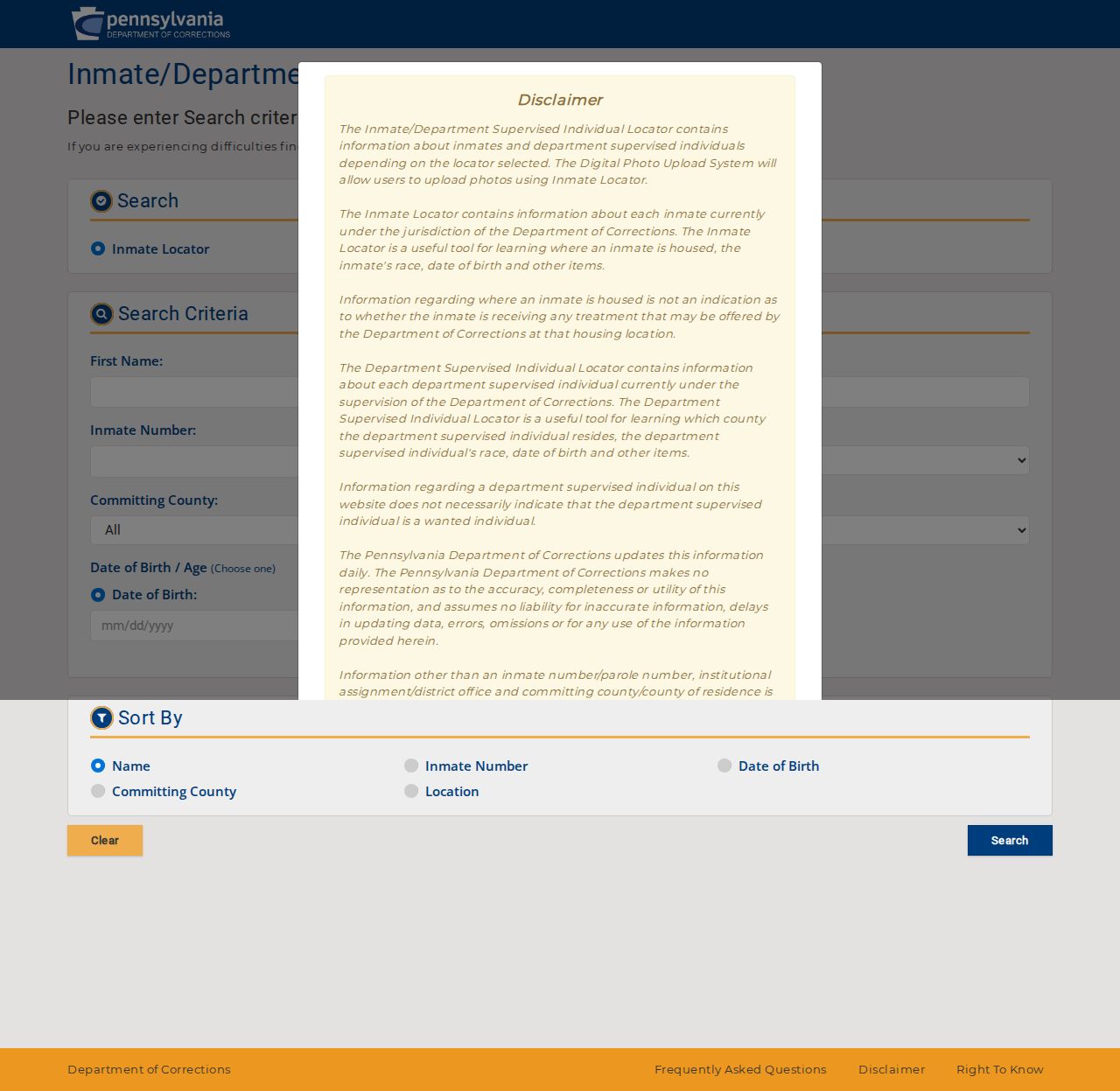
The interface supports current custody and current supervision checks, which is why an archival request remains essential after final discharge.
Pennsylvania Release Date Meanings
Pennsylvania uses minimum and maximum sentence concepts. The ordinary minimum is generally the first point when the Parole Board may exercise discretion, not a promised release day. The maximum is the expiration boundary for that sentence calculation, but another sentence, detainer, or lawful recalculation may keep custody in place. A favorable Board decision can also require completion of a home plan or other conditions before departure.
An RRRI minimum may apply to a person whom the sentencing court found eligible under the Recidivism Risk Reduction Incentive framework. PADOC describes it as three-fourths of an ordinary minimum of three years or less, or five-sixths when the ordinary minimum exceeds three years. Certification requirements, statutory exclusions, and Board action still apply. RRRI is not a blanket credit.
The research did not verify a public PADOC field literally titled “Projected Release Date” or “Tentative Release Date,” and it found no promise of a permanent released-person result. Use the exact label visible on the current record. Then gather the sentencing order, time-credit calculation, Board Action, and final release or movement record before stating an actual date.
Pennsylvania Parole and Final Discharge
A supervised-individual match supports current community supervision by PADOC. It does not establish the exact time the person left a state institution. The parole office finder can identify the current field office, while a Board Action supplies the official decision terms. A decision may grant parole to the street or to a detainer, and those outcomes are not equivalent.
Final discharge is different from parole. Parole keeps the person under department supervision until the applicable status ends. Once the maximum expires or another final action closes supervision, neither current locator is guaranteed to retain the person. Historical proof then rests on the PADOC discharge or movement record, the Board file, and the court docket.
A home plan can also separate a favorable decision from an actual departure. PADOC's official home-plan material says an in-state investigation typically can take up to 45 days. Programming, plan approval, transportation, a detainer, another sentence, or later Board action may also affect the final event. For that reason, record the decision date and the actual release date as separate facts. If the result says parole to a detainer, follow the receiving authority because the person did not enter the community at that point.
Use identity safeguards throughout. Compare DOC or parole number, date of birth or age, committing county, and case information. Never merge two people because their names and county resemble one another. When records conflict, ask the responsible custodian to correct or explain the source rather than selecting the most convenient date.
A state result should also be checked against its Butler origin when the custody trail began locally. The Butler County Prison can confirm whether its stay ended in a PADOC transfer, the County Open Records route can produce the existing local event record, and the Clerk of Courts can route the Common Pleas case file. That comparison separates county departure from later state parole or discharge.
Note: A Pennsylvania parole decision establishes the Board's action, while the final PADOC record establishes the later custody event.